

Standard Centrifugal Pump v Changing State Pump Explainer
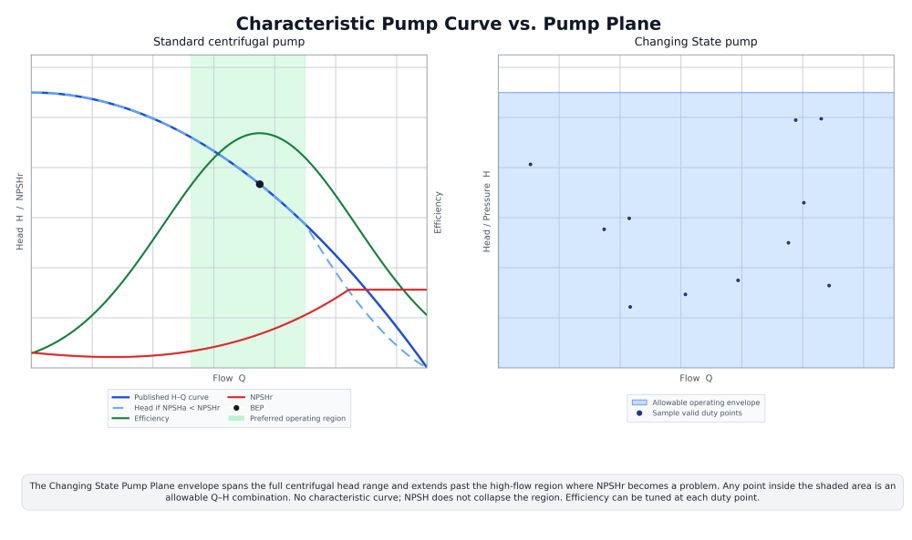
Standard centrifugal pump (left panel)
• Operation is locked to a single fixed characteristic curve (the Head(H)/Discharge (Q) curve). For any given flow, there is only one head the pump can produce — the operator cannot independently choose Q and H.
• Efficiency peaks at one point (Best Efficiency Point - BEP) and falls off on either side, so there's really only a narrow "preferred operating region" (shaded green band) where the pump runs well. Outside that band, efficiency drops off sharply.
• The Net Positive Suction Head required, NPSHr, rises steeply with flow. Once flow increases past the point where available NPSH can no longer meet what the pump requires, the actual head produced falls away from the published curve (the dashed light-blue line diverging from the solid dark-blue curve). This is a hard physical constraint — high flow plus insufficient suction head causes cavitation and lost performance, not just an efficiency penalty.
• Net effect: the usable operating space is really a thin line (the curve itself), further restricted by an even thinner "good efficiency" segment, and further restricted again at high flow by NPSH limitations.
Changing State pump (right panel)
• There is no single characteristic curve. Instead, there's a broad allowable operating envelope (the shaded blue region) — any Q–H combination inside that area is achievable, not just points along one line.
• The sample duty points scattered through the envelope illustrate this: the pump can be run at low flow/low head, high flow/high head, low flow/high head, or high flow/low head — combinations a fixed-curve centrifugal pump simply cannot reach without changing impellers, trimming, or speed.
• Because the envelope spans the full head range and extends through the high-flow region without narrowing, NPSH does not act as a boundary that collapses the usable area the way it does for the centrifugal pump. High flow doesn't force a trade-off against available suction head in the same way.
• Efficiency is described as tuneable at each duty point rather than fixed by where you sit on a single curve, meaning good efficiency isn't confined to one narrow band — it can potentially be optimized across a much wider range of operating conditions.
Key takeaway
The standard centrifugal pump's operation is one-dimensional in practice (a single H–Q relationship), with both the "good efficiency" zone and the achievable high-flow region constrained by NPSHr. The Changing State pump operates in a genuinely two-dimensional plane — flow and head can be selected largely independently within a wide envelope — and NPSH is not the limiting factor that shrinks that envelope at higher flows. This gives it substantially more flexibility to meet varying duty conditions without the performance penalties or cavitation risk that constrain conventional centrifugal pumps at the edges of their curve.
Work with Changing State Technologies
CST is interested in speaking with pump OEMs, industrial end users, investors and technical partners.
Whether you want to explore OEM integration, trial the technology in a real-world application or understand the broader market opportunity, our team is ready to start the conversation.
Stay up-to-date with CST
Latest developments, news and break-throughs direct to your email.